


One of the biggest issues with setting up a smart home is its reliance on Wi-Fi. Your home network can slow down immensely when you're putting a bunch of Internet of Things (IoT) devices on it, which many smart home devices are. If your devices are overly reliant on Wi-Fi, they can cause your entire home to move slower than you like. It can cause a snowball effect throughout the home.
There are ways around relying on Wi-Fi for your smart home devices. Options like choosing Zigbee, Z-Wave, and Thread devices can create their own low-frequency network that helps them connect to one another and avoid the reliance on Wi-Fi. Bluetooth is another option, although it's not always as reliable as Wi-Fi and the other protocols. Another way to set up your smart home is with devices that use the LoRaWAN standard to connect.
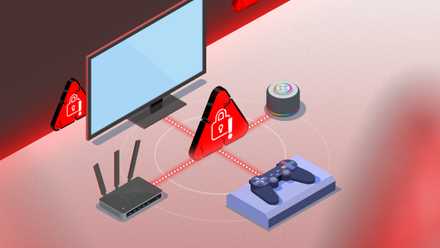
The 6 Most Vulnerable Devices In Your Home—and How to Secure Them
Your home is packed with internet-connected devices, but are they all secure from hackers, scammers, and other threats?
What is LoRaWAN?
This can work across a long distance

Long Range Wide Area Network (LoRaWAN) is a specification that wirelessly connects devices across a far distance. It aims to connect battery-operated devices to the internet wirelessly. This happens in global networks worldwide.
LoRaWAN is a Media Access Control (MAC) layer protocol that works on top of the LoRa modulation. The LoRa modulation is derived from the Chirp Spread Spectrum (CSS). Essentially, LoRa takes data and information and encodes it in radio waves with chirp pulses. LoRaWAN takes those data packets and chirps and translates them into data packets. It takes those chirps and moves them to a network server.
LoRa gateways will listen for chirps from vast distances, as these can reach up to 15 kilometers, providing a wide coverage. LoRaWAN will encrypt the data to keep it secure as it moves it to a server. The chirps are spread out based on how close they are to a server or a gateway.
A lot of the reasons why people rely on LoRaWAN in rural settings is because of its vast coverage in areas where Wi-Fi may not be prevalent. It might be their only option.
To avoid the gateway and network from getting clogged, LoraWAN controls the communication between the device and the gateway by working out the timing, so as not to overlap chirps. This lets the devices take commands efficiently.
LoRaWAN is a different way of connecting your smart home devices because it uses a single central gateway to cover your entire home, rather than relying on something like the mesh network that Thread creates between its devices or Wi-Fi. It operates in low power mode and has a broad range, making it more expansive than other standards.
What you need to make LoRaWAN work
There are a few items that you can use for your smart home

In order to get the desired communication, there are multiple layers at play for LoRaWAN to work. There is hardware that's needed to be utilized to pass that information back and forth.
There needs to be sensors of some kind, or nodes. These communicate with the gateway on behalf of the devices. The gateway acts as a checkpoint, taking the information from the nodes and sending it where it needs to go, which is onto the network server.
The network server is meant to then take that data and process it. It is usually something like a Raspberry Pi with Home Assistant that someone can use from home. There are more expensive options and cheaper ones as well. Many network servers also serve as application servers as well, which can actually make your devices respond to the commands.
What you need to buy are sensors or devices that have nodes that are LoRaWAN compatible. There are many ways to utilize LoRaWAN in smart homes, such as using sensors to monitor temperature and humidity as well as monitoring items, such as a mailbox, shed, or door. Placing a sensor on any of these can be collected and the information shared because of LoRaWAN.
You need to find devices that specifically say they support LoRaWAN. If the box of the device says it only supports LoRa, it likely won't also support LoRaWAN. LoRaWAN needs to be called out on the package for you to feel safe that it will work.
These smart home devices are LoRaWAN musts
It's fun to see how to use these for good
It isn't your fault if none of the smart home devices you currently have are LoRaWAN compatible. You may not have been looking for those kinds of devices, which aren't the same as your smart speakers and smart plugs.
LoRaWAN devices tend to be more niche and more righteous in a way, meaning that they are focused on serving a greater purpose than letting you watch Netflix. People use LoRaWAN devices on farms to help monitor crops and help with proper watering. A lot of the reasons why people rely on LoRaWAN in rural settings is because of its vast coverage in areas where Wi-Fi may not be prevalent. It might be their only option.
Something like the Seven-S TG560A LoRaWAN smoke detector makes sense to have in homes. HBI Bisscheroux bv Serie 110 Circum lights are frequently used in common areas, as these kinds of lights are great for smart buildings. A landlord can install this kind of device in a building they own and cast the low power network that covers the entire building, not just one apartment, as it works well indoors, deeply penetrating walls unlike Wi-Fi. Antenna like the Slinkdsco Waterproof 5.8dBi Meshtastic Lora 915MHz Solar Node can serve as the sensor that you need and link up to the rest of your hardware.
The DIYmalls 915 MHz LoRa GPS Module can be used with a LoRaWAN gateway like a RAK WisGate Developer D0+ to process the data from your sensors. You can browse resources like the LoRa Marketplace from LoRa Alliance to see other LoRa and LoRaWAN compatible devices for your smart home.
Adding this to your home is a way to get your smart home running efficiently
If you're looking for ways to get more out of your smart home, you might want to consider relying on LoRaWAN devices. These can do a lot of monitoring for you and the coverage the standard provides is impressive. It's important to get the right equipment in order to run this and an antenna would be a big help. It will be interesting to see how the compatible devices list grows for this.

Slinkdsco 5.8dBi Meshtastic LoRa antenna
The Slinkdsco 5.8dBi Meshtastic LoRa antenna offers a wide frequency range and works with Meshtastic nodes.